
Our research in myside bias in legal settings. Funded by the British Academy and Leverhulme Trust.



EduClips: Myside bias in civil litigation
Four short videos explaining our research in myside bias in civil litigation.
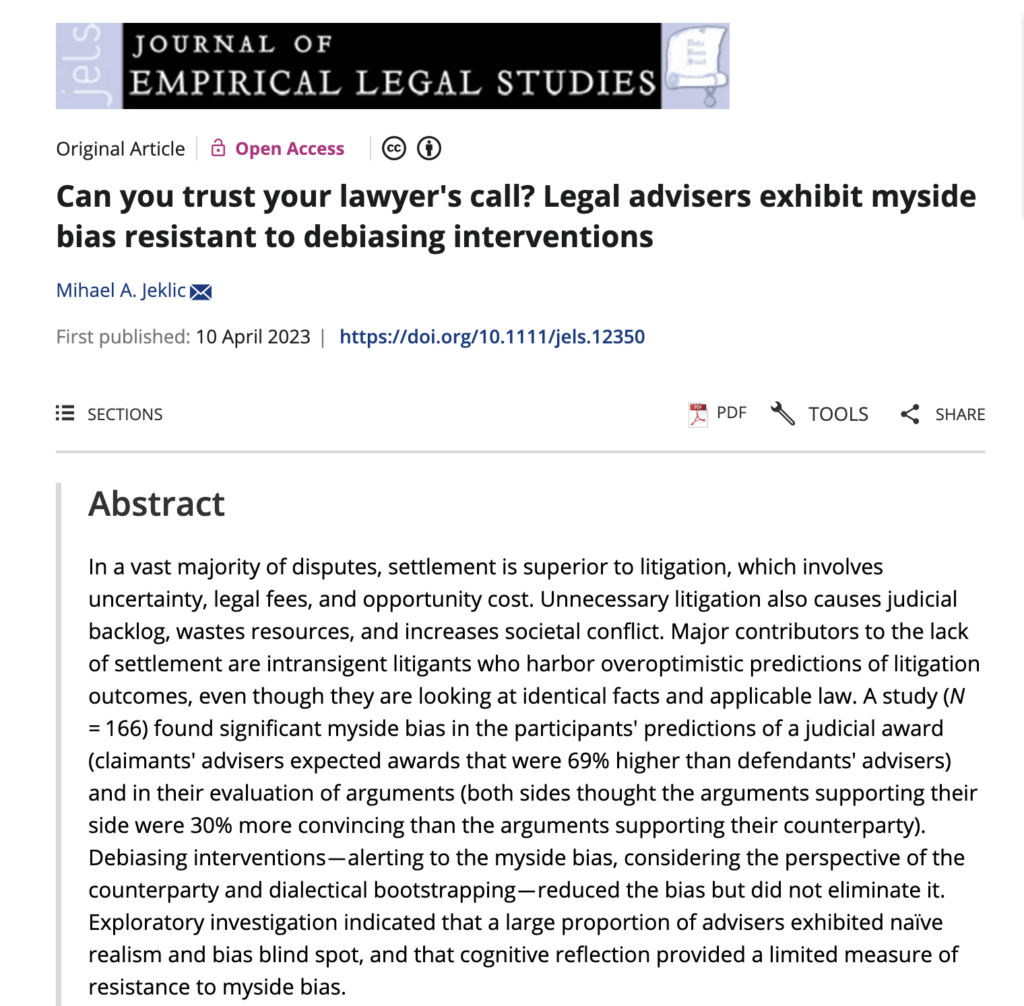
Jeklic, M. A. (2023). Can you trust your lawyer’s call? Legal advisers exhibit myside bias resistant to debiasing interventions. Journal of Empirical Legal Studies, 20(2), 409–433. https://doi.org/10.1111/jels.12350
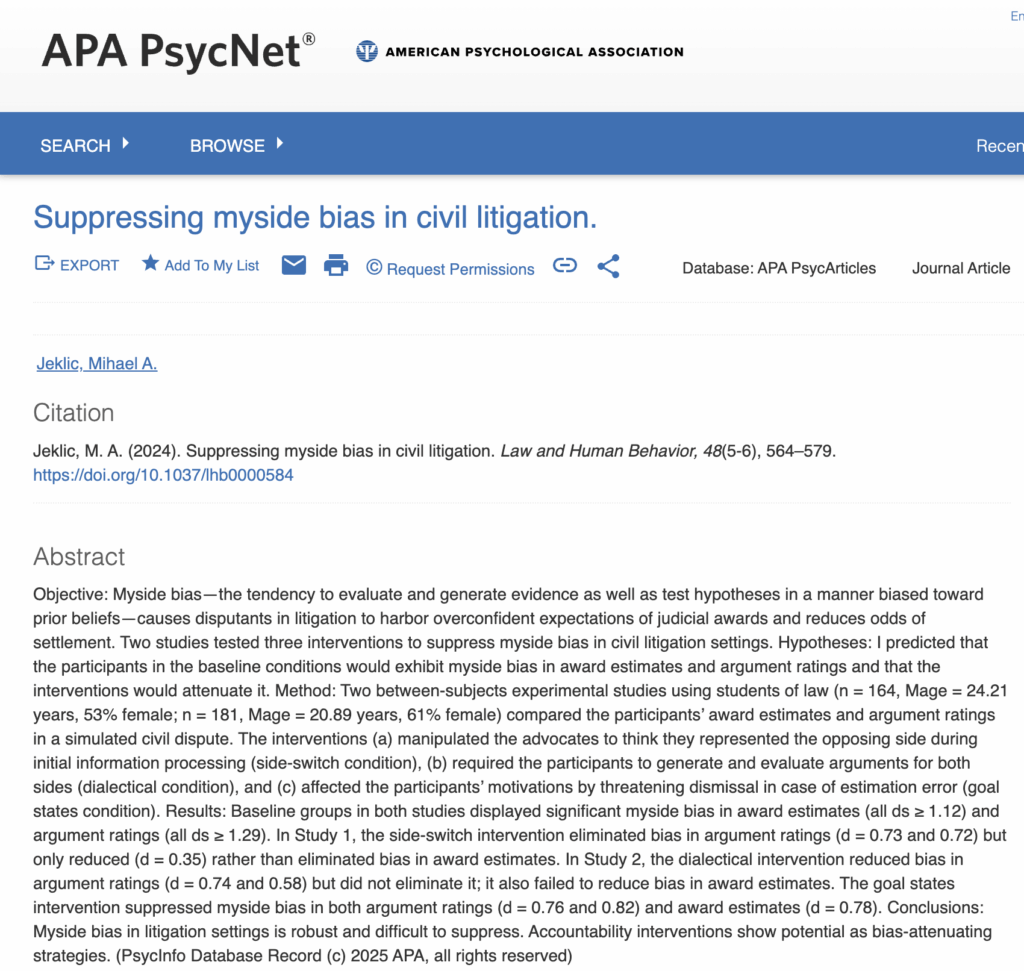
Suppressing myside bias in civil litigation
Jeklic, M. A. (2024). Suppressing myside bias in civil litigation. Law and Human Behavior, 48(5-6), 564–579. https://doi.org/10.1037/lhb0000584
‘When lawyers predict case outcomes: myside bias and overconfidence in legal advice’, symposium held at King’s College London on 24 April 2025.
In litigation and arbitration, optimism about outcomes can be helpful, but at what cost? Studies show that lawyers, irrespective of intelligence or demographic status, consistently exhibit unwarranted confidence in their client’s case even when presented with the same facts and legal rules. This is known as myside bias, the propensity of people to evaluate evidence, generate evidence, and test hypotheses in a way biased toward prior beliefs, opinions, and attitudes. In the dispute resolution domain, this bias can inflate judicial outcome expectations, reduce settlement rates, and prolong and escalate costly conflicts.
The interdisciplinary panel discussed two years of research funded by The British Academy and The Leverhulme Trust into the mechanics and nature of myside bias, the correction and suppression interventions, the implications for litigation and dispute resolution, and practical strategies that lawyers, judges, and negotiators can use to mitigate bias and achieve fairer outcomes.